Swipe up and discover all the videos and insights
METHODS OF CHIPPING FLINT
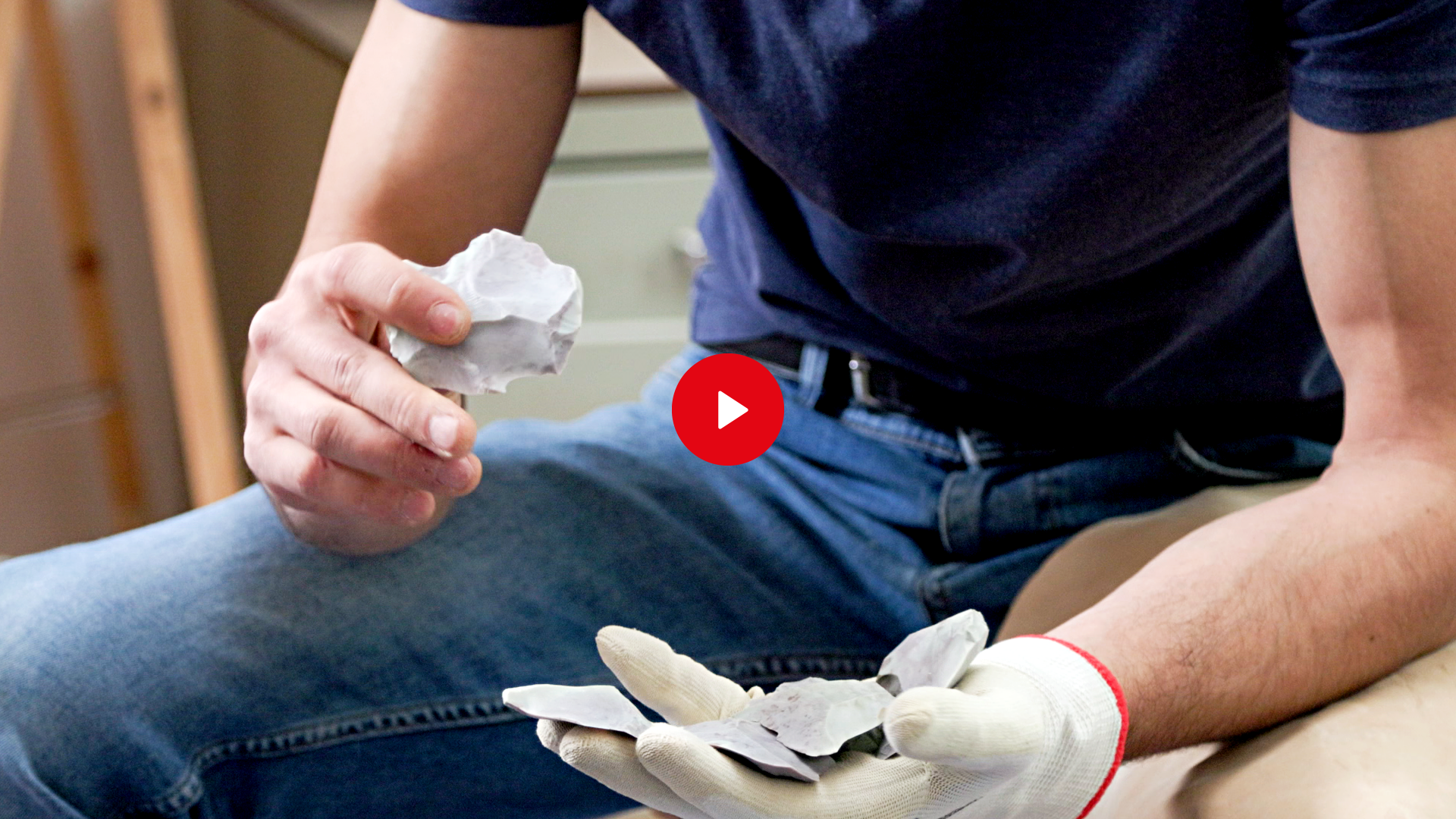
Tap the "PLAY" button to see the video or drag up to see other videos
TOOLS OF THE MIDDLE PALEOLITHIC
In the Middle Paleolithic, large groups of stone industries develop on the basis of regional traditions, giving shape to a considerable technological and economic variability: besides the persistent manufacture of bifacial and the Levallois method, other chipping methods appear, such as the Discoid and the Laminar. Their products, of various shape and size, are used thanks to their sharp edges, or transformed into tools such as scrapers and denticulates used in different activities, such as slaughtering and wood working.
Tap the buttons to read more or watch videos
Tap the red buttons to read all the text, or to watch the video.
Then drag the page up to see other available content
TOOLS OF THE UPPER PALEOLITHIC
With the arrival of Homo sapiens and the spread of major innovations of the Upper Paleolithic, we witness the development of exchange networks, even over long distances, the affirmation of new technologies in the production of lithic instruments, in its functional specialisation and standardisation, in the clear distinction between that of daily use and that of hunting. At the same time, new tools from animal hard materials such as needles, daggers, perforators and thrusters spread. Bow and arrows appear, attested by rare but exceptional discoveries.
INDIRECT PERCUSSION
The indirect percussion technique involves the use of a chisel made of organic material (punch), usually a deer stage section, which is struck by a wooden or stone hammer. The precision in locating the point of impact on the flint core and the separation angle close to 90 degrees allow better control in chipping of blades and bladelets, which results in more regular, straight and standardized products. With good quality flint, this technique allows the production of blades to be optimised, obtaining a high proportion of functional margins per unit of raw material.
THE MICROBULINO TECHNIQUE
The microburin is a retouching technique that allows the controlled segmentation of blade or bladelet. The resulting microburin is a processing residue which is almost never used, on the other hand a blade portion with an extremely sharp oblique truncation (piquant trièdre) is obtained, which can be further retouched or exploited as such. This technique is usually associated with the production of geometric arrowheads.
LAMINATING METHOD
The laminar method is a predetermined chipping mode which, through careful preparation and management of the core morphology, allows regular and elongated blades to be produced in series. The first blades are detached following a natural guide rib or prepared by orthogonal flaking, and then the negative left by each blade serves as preparation for the next. If carried out accurately, with few and appropriate management adjustments, this method allows an almost uninterrupted production of regular blanks until the core is exhausted.
THE GEOLOGICAL RESOURCES IN THE BERICI
The rocks of the Berici are mainly calcareous, of age between the Late Cretaceous and the Miocene (between 90 and 5 million years ago), with local basaltic intrusions of eocenic age. The rocks have settled in environments of open sea (Scaglia), carbonatic platform (Eocene, Oligocene) or for actions of erosion and transport of pre-existing rocks (Miocene).